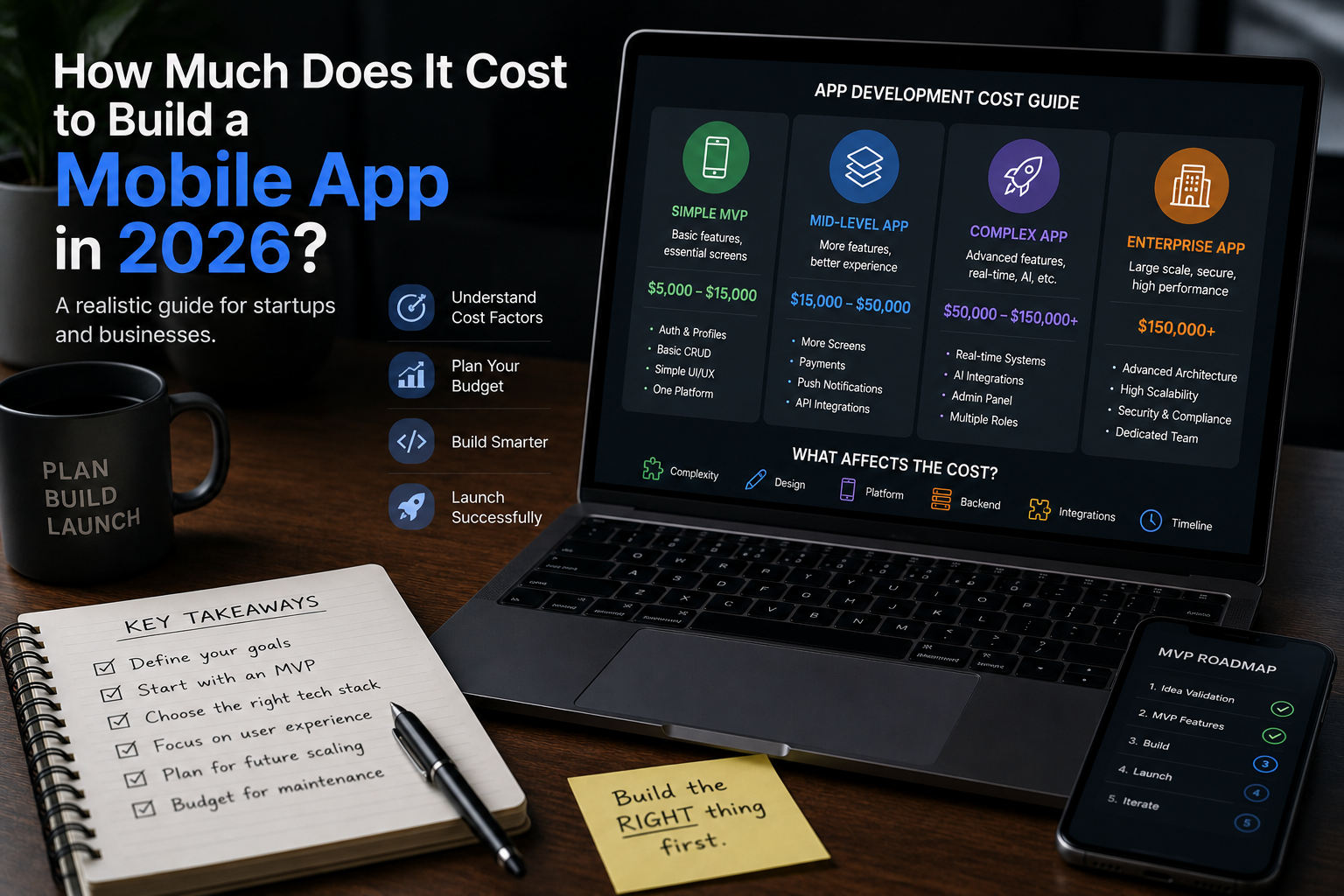
How Much Does It Cost to Build a Mobile App in 2026?
One of the first questions every startup founder or business owner asks is:
“How much does it cost to build a mobile app?”
The problem is:
most answers online are vague, unrealistic, or written purely for SEO.
You’ll see things like:
“Apps cost between $5,000 and $500,000.”
“It depends.”
“Contact us for a quote.”
Technically true.
Practically useless.
This guide breaks down what actually affects mobile app development cost in 2026, what businesses underestimate, and how to avoid wasting money before development even starts.
Whether you're building:
a startup MVP,
an internal business tool,
a marketplace,
an AI-powered app,
or a SaaS platform,
the same principles apply.
The Short Answer
A real production-ready mobile app in 2026 typically costs:
Project TypeEstimated CostSimple MVP$5,000 – $15,000Mid-Level Startup App$15,000 – $50,000Complex SaaS / Marketplace$50,000 – $150,000+Enterprise-Level Platform$150,000+
If someone promises:
“We can build your Uber-like app for $999.”
run.
You’re either getting:
a template,
terrible architecture,
or a project that becomes impossible to scale later.
Usually all three.
What Actually Determines Mobile App Development Cost?
Most businesses think app pricing is based on:
number of screens,
visual design,
or platform choice.
Those matter.
But the real cost drivers are deeper.
1. Complexity of the Product
This is the biggest factor.
A basic app with:
authentication,
profile management,
and simple CRUD operations
is dramatically cheaper than an app with:
real-time systems,
AI integrations,
subscriptions,
payments,
media processing,
admin dashboards,
analytics,
or chat systems.
Example
Low Complexity
Fitness tracker
Company internal app
Appointment booking app
Medium Complexity
Marketplace app
Delivery app
Social platform
High Complexity
AI-powered SaaS
Real-time video platform
Multi-role ecosystem apps
2. Backend Infrastructure
Many non-technical founders think the mobile app is the product.
Usually, the backend is where most of the complexity lives.
A modern app often requires:
APIs,
databases,
authentication,
cloud storage,
admin systems,
notifications,
analytics,
payment processing,
AI integrations,
automation systems.
This is why serious app development is much more than “designing screens.”
3. iOS, Android, or Both?
Building separate native apps:
Swift for iOS
Kotlin for Android
costs significantly more.
That’s why many startups now choose:
React Native
Flutter
for cross-platform development.
Why Businesses Choose React Native
With React Native:
one codebase,
faster development,
lower maintenance costs,
simultaneous iOS + Android release.
For startups and SMBs, this is usually the most practical option.
4. UI/UX Design Quality
Cheap apps look cheap.
And users notice immediately.
Good UI/UX is not about “making things pretty.”
It directly impacts:
retention,
trust,
conversion,
onboarding success,
subscription revenue.
A bad user experience can kill a product even if the backend is technically solid.
5. AI Features Increase Complexity
This is one of the biggest shifts happening right now.
Businesses increasingly want:
AI chat,
voice assistants,
image generation,
transcription,
recommendation systems,
automation tools.
But AI features are not:
“Just connect ChatGPT API.”
Real AI product engineering involves:
prompt architecture,
validation systems,
rate limiting,
cost optimization,
structured outputs,
fallback handling,
moderation,
reliability engineering.
AI apps can become expensive very quickly if architecture is poorly planned.
The Biggest Mistake Businesses Make
They try to build everything at once.
This destroys:
budget,
speed,
focus,
and product quality.
The smartest startups build:
MVPs first.
What Is an MVP?
MVP = Minimum Viable Product.
Meaning:
smallest functional version,
fastest path to real users,
validation before scaling.
A proper MVP should answer:
“Do people actually want this?”
before you spend massive money.
MVP vs Full Product
Smart Approach
Launch:
core features only,
gather feedback,
iterate fast.
Bad Approach
Spend:
8 months,
huge budget,
massive feature list,
before validating demand.
This is how many software projects fail before launch.
Why Cheap Development Usually Becomes Expensive Later
Businesses often optimize for:
lowest upfront cost.
That’s understandable.
But low-quality development creates:
technical debt,
scalability problems,
security issues,
performance bottlenecks,
rewrite costs later.
A badly built app can cost more to fix than rebuilding from scratch.
What Businesses Should Look For in a Software Company
Don’t only evaluate:
price,
portfolio visuals,
or promises.
Look for:
communication quality,
architecture thinking,
scalability planning,
business understanding,
product strategy.
A good software company should challenge bad ideas.
Not blindly say yes to everything.
Questions You Should Ask Before Hiring a Mobile App Development Company
Technical Questions
What stack do you use?
How do you handle scalability?
How do you structure backend architecture?
How do you handle app security?
Product Questions
Should this be an MVP first?
What features should wait?
What are the biggest risks?
Business Questions
What are ongoing maintenance costs?
How long will updates take?
What happens after launch?
If a company cannot answer these clearly, that’s a red flag.
The Real Cost Nobody Talks About: Maintenance
Apps are not one-time purchases.
After launch:
bugs happen,
APIs change,
Apple updates policies,
Android versions evolve,
users request features.
Maintenance is part of software ownership.
Businesses that ignore this usually struggle later.
So… How Much Should You Budget?
Here’s a more realistic mindset:
Small Startup MVP
Budget:
$10k–$25k
Serious SaaS Platform
Budget:
$30k–$100k+
AI-Powered Product
Budget:
Higher than expected.
Because AI adds:
infrastructure costs,
engineering complexity,
ongoing API expenses.
Final Thoughts
Building a mobile app in 2026 is easier technically than ever before.
But building a successful app is still difficult.
The companies that succeed usually:
start lean,
validate early,
focus on UX,
prioritize scalability,
and avoid feature overload.
The goal is not:
“Build everything.”
The goal is:
“Build the right thing first.”
That’s the difference between:
shipping products,
and burning budget.
Feeling stuck and got similar questions like below ? Contact me today !
how much does it cost to build a mobile app
mobile app development cost 2026
app development company pricing
startup MVP development cost
React Native app development company
custom mobile app development services
AI app development company
cost to build SaaS app
cross platform mobile app development
mobile app development for startups
Email: sio@softwarify.co