Most developers don’t fail because they can’t code. They fail because they’re solving the wrong thing in the wrong way of thinking.
There’s a massive difference between a task-oriented developer and a product-oriented developer. And if you’re building anything that needs users, revenue, or real-world impact, that difference decides whether you’re just “shipping features” or actually building something that matters.
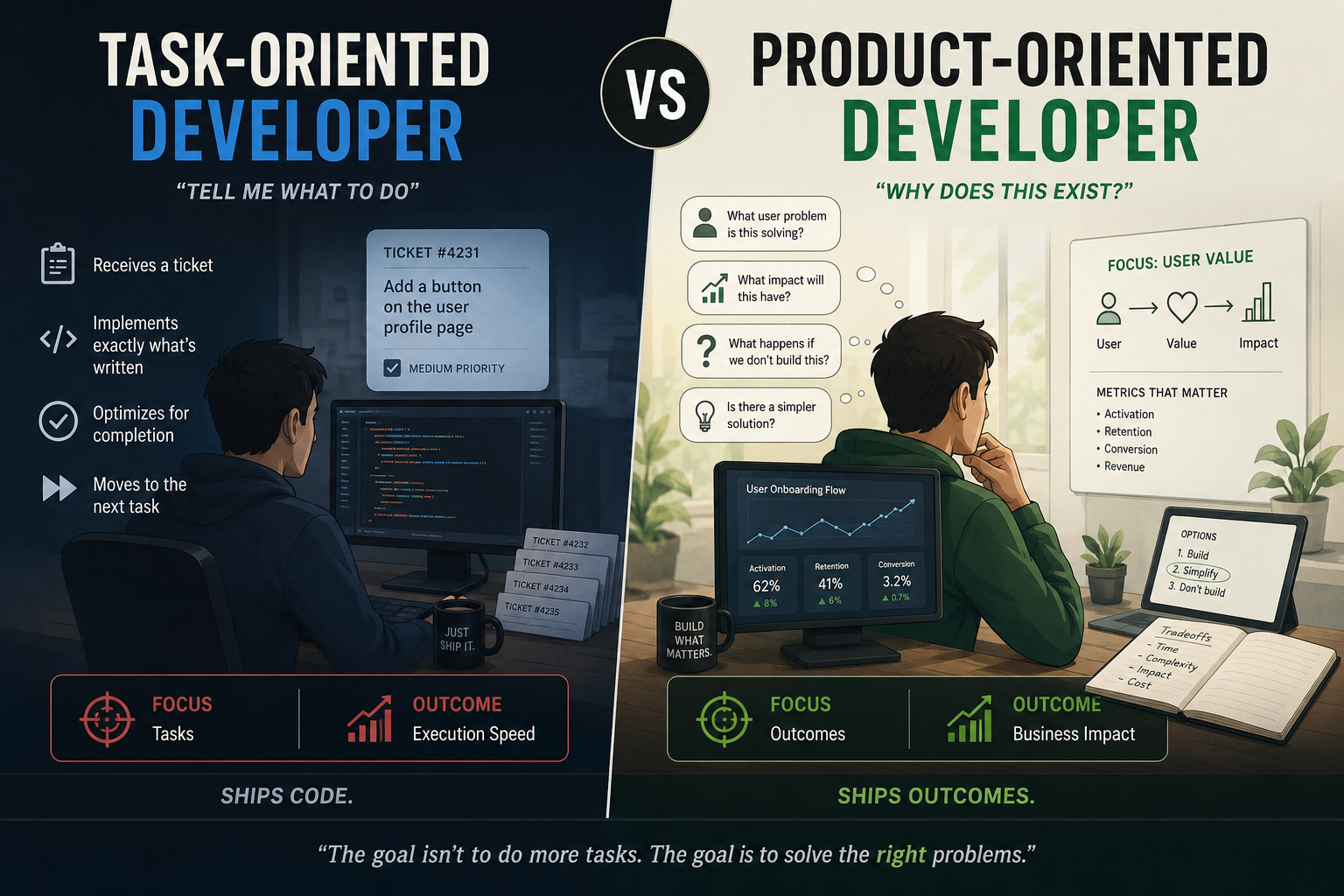
Task-Oriented Developer: “Tell me what to do”
A task-oriented developer works like this:
Receives a ticket
Implements exactly what’s written
Optimizes for completion
Moves to the next task
They’re efficient. Often fast. Usually technically solid.
But there’s a hidden problem: they don’t think beyond the task.
If the ticket says “add a button,” they add a button.
If it says “fix this bug,” they fix the bug in isolation.
If the feature makes no sense for users, they still ship it.
The mindset is: “Is this done?”
Not: “Should this exist?”
That creates a dangerous outcome in product companies: a fast-moving system that slowly drifts away from user value.
Product-Oriented Developer: “Why does this exist?”
A product-oriented developer thinks differently.
Before writing code, they ask:
What user problem is this solving?
Is this the best way to solve it?
What happens if we don’t build this?
Is there a simpler solution?
They still execute tasks, but they don’t blindly accept them. They interrogate them.
They care about outcomes, not just output.
If something feels off, they push back. If something is over-engineered, they simplify it. If a feature doesn’t move metrics or user value, they question it.
This mindset turns a developer into a product force multiplier.
The real difference: ownership
Task-oriented thinking produces execution speed.
Product-oriented thinking produces business impact.
One ships code.
The other ships outcomes.
That’s the core gap.
And it shows up everywhere:
Task dev: “API is done”
Product dev: “Does anyone actually need this endpoint?”
Task dev: “UI matches design”
Product dev: “Does this flow convert or confuse users?”
Task dev: “Bug fixed”
Product dev: “Why did this bug exist in the first place?”
Why most developers stay task-oriented
It’s not laziness. It’s structure.
Most teams unintentionally train developers to be task executors:
Jira tickets with no context
“Just implement this”
No exposure to metrics
No product feedback loop
No ownership of outcomes
If you grow inside that environment, you naturally optimize for finishing tasks, not understanding impact.
The uncomfortable truth
Being task-oriented is safe.
You don’t argue. You don’t question. You don’t take responsibility for outcomes.
But it also caps your growth.
Because at senior levels, no one cares how many tickets you closed.
They care about:
Did user retention improve?
Did revenue increase?
Did the product get better?
Did you make good decisions when ambiguity existed?
If you can’t operate in that space, you plateau—no matter how good you are at coding.
How to become product-oriented (without becoming “PM-lite”)
This is where people mess up. Becoming product-oriented doesn’t mean turning into a pseudo product manager.
It means upgrading how you think while still being an engineer.
Start with this:
1. Always ask “why”
Before building anything, force context:
Why are we doing this?
What triggered this request?
2. Understand the metric behind the feature
Every feature exists for a reason:
Conversion
Retention
Activation
Revenue
If you don’t know the metric, you’re blind.
3. Push for simplest possible solution
Not the most flexible. Not the most scalable. The simplest that solves the problem.
4. Think in tradeoffs, not solutions
No feature is free. Every decision costs something.
5. Care about usage, not just delivery
Shipping is not the finish line. It’s the starting point of feedback.
Final thought
Task-oriented developers are easy to manage, but easy to replace.
Product-oriented developers are harder to manage, but much harder to replace.
If you’re building a career—or a company—you don’t want to be the person who just closes tickets.
You want to be the person who changes what gets built in the first place.