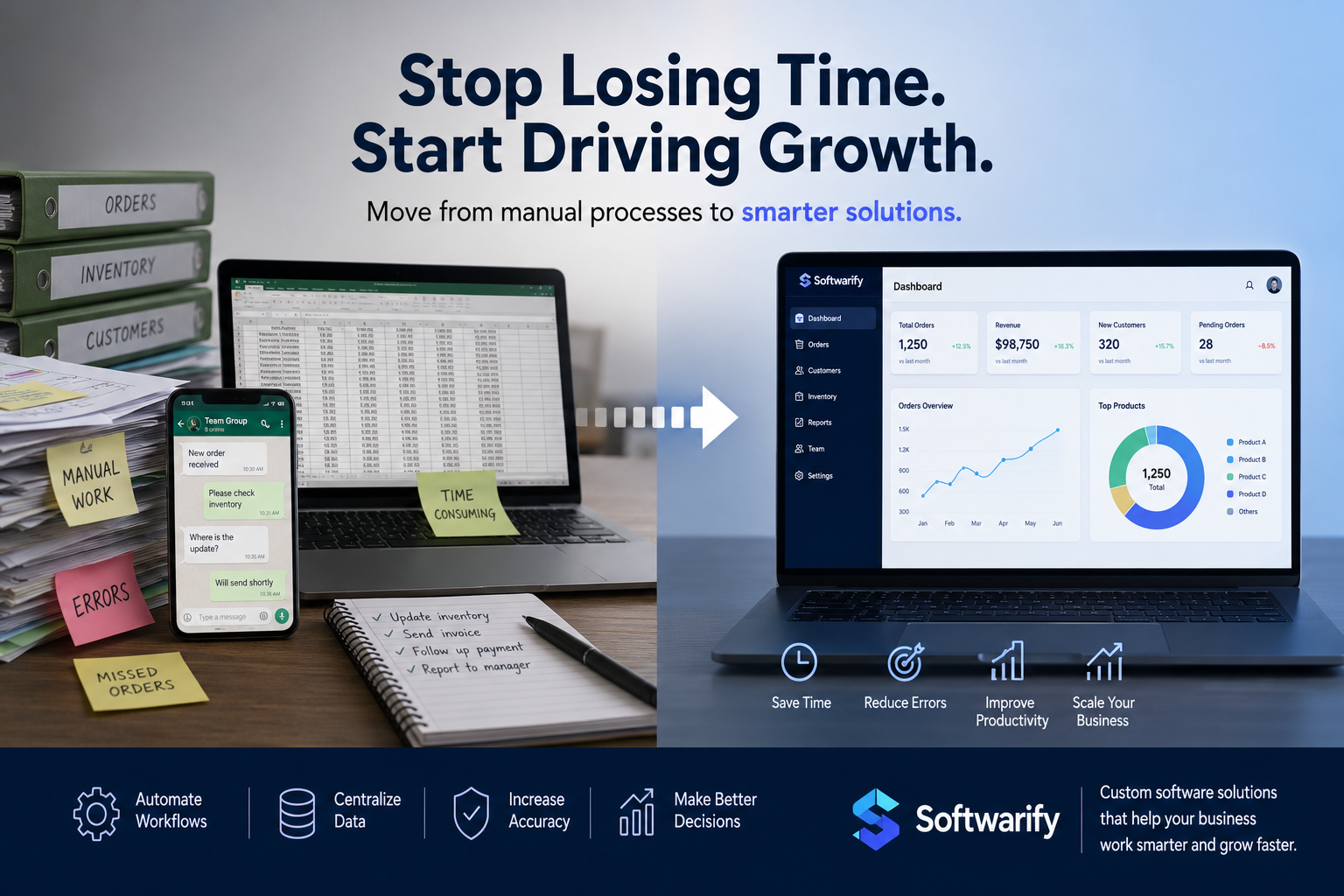
Most businesses don't realize they're losing money every single day.
Not because they lack customers.
Not because they have a bad product.
But because their operations are held together by spreadsheets, WhatsApp messages, and manual work.
At first, this seems normal.
A spreadsheet tracks inventory.
A WhatsApp group manages field teams.
A few employees manually transfer data between systems.
Everything works—until the business starts growing.
Then the hidden costs begin to appear.
The Problem Isn't the Spreadsheet
Excel is a fantastic tool.
WhatsApp is incredibly convenient.
The real issue is using them as business infrastructure.
When critical business processes depend on manual actions, every growth milestone creates new friction:
More customers mean more data entry.
More employees mean more communication chaos.
More orders mean more opportunities for mistakes.
More reports mean more time spent collecting information.
Eventually, people spend more time managing work than actually doing work.
Small Inefficiencies Become Expensive
Imagine a team of 10 employees.
If each employee loses just 30 minutes per day due to manual processes, that's:
5 hours per day
25 hours per week
Over 100 hours per month
That's the equivalent of hiring an additional employee just to compensate for inefficiency.
Most businesses never see this cost because it's hidden inside daily operations.
But it's there.
Every single day.
The Real Cost of Human Error
Manual workflows create mistakes.
Orders get missed.
Customer information gets entered incorrectly.
Invoices are delayed.
Inventory records become inaccurate.
Most businesses focus on the direct cost of fixing these mistakes.
What they don't calculate is the impact on customer trust.
One delayed order might seem insignificant.
Ten delayed orders can damage a company's reputation.
Why Businesses Wait Too Long
Many business owners know their processes are inefficient.
They simply assume software development is:
Too expensive
Too complex
Too time-consuming
This belief often costs more than the software itself.
Every month spent operating inefficiently is another month of lost productivity, avoidable mistakes, and missed growth opportunities.
Custom Software Isn't About Technology
Many people think custom software is about having a fancy dashboard or a mobile app.
It's not.
The goal is to remove friction.
Good software should:
Eliminate repetitive tasks
Reduce human error
Centralize information
Improve decision-making
Help teams scale without proportional increases in workload
Technology should simplify operations, not complicate them.
Start with the Bottleneck
You don't need to automate your entire business overnight.
The smartest approach is identifying the biggest bottleneck first.
Ask yourself:
Which process consumes the most employee time?
Where do mistakes happen most often?
Which task would you never want to perform manually again?
That bottleneck is usually where software delivers the highest return on investment.
Final Thoughts
Growth doesn't break businesses.
Inefficient processes do.
Many companies try to solve operational problems by hiring more people.
The better solution is often building better systems.
The businesses that scale successfully aren't necessarily the ones with the biggest teams.
They're the ones that eliminate friction before it becomes a problem.
If your team is spending hours every week moving data between spreadsheets, sending repetitive messages, or managing manual workflows, it may be time to rethink the way your business operates.
Because every manual process has a cost—even when it doesn't appear on your balance sheet.