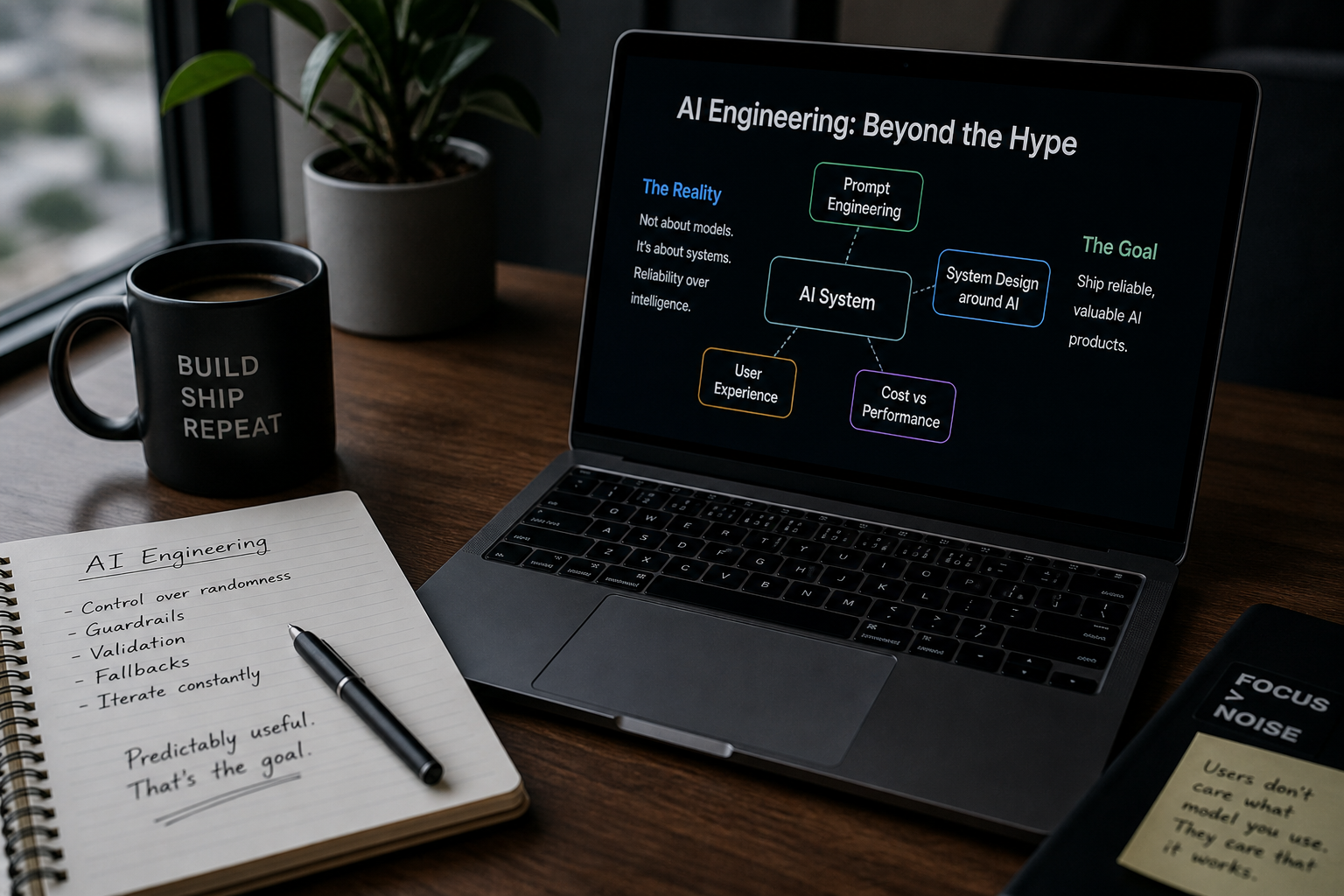
Everyone is talking about AI.
Founders are pivoting to it. Developers are rushing to “learn it.” Companies are rebranding themselves around it.
But most of what you see online about AI engineering is either surface-level tutorials or hype-driven noise.
This post is not that.
This is what AI engineering actually looks like when you’re building real products.
AI Engineering Is Not About Models
If you think AI engineering = training models, you’re already off track.
In practice, you rarely train models from scratch.
What you actually do is:
Use existing models (LLMs, vision models, embeddings)
Wrap them with logic
Control their behavior
Integrate them into real systems
The real challenge is not intelligence.
It’s reliability.
The Core Problem: Control
AI systems are probabilistic.
Your backend APIs are not.
That mismatch creates friction.
You don’t “call AI” like a normal function:
const result = await generateText(prompt);You’re dealing with:
Inconsistent outputs
Hallucinations
Formatting issues
Latency spikes
Cost tradeoffs
So your job becomes:
How do I make something unpredictable behave predictably enough for users?
What Real AI Engineering Involves
Here’s what actually matters:
1. Prompt Engineering (But Not the Way You Think)
It’s not about clever one-liners.
It’s about:
Structuring inputs
Creating constraints
Designing outputs (JSON > plain text)
Iterating constantly
Bad prompt = unstable product.
2. System Design Around AI
You don’t build with AI.
You build around AI.
That means:
Fallback systems
Validation layers
Retry logic
Guardrails
Example:
if (!isValidJSON(response)) {
  retryWithStrongerPrompt();
}
3. Cost vs Performance Tradeoffs
Bigger model ≠ better product.
You constantly balance:
Speed
Cost
Output quality
Sometimes a smaller, faster model with better constraints wins.
4. UX Matters More Than You Think
AI is not the product.
The experience is.
Users don’t care what model you use.
They care that:
It works consistently
It feels fast
It doesn’t break
The Biggest Mistake Developers Make
They build demos.
Not products.
A demo:
Works once
Looks impressive
Breaks under real usage
A product:
Handles edge cases
Recovers from failure
Scales (technically and financially)
If your AI feature only works in ideal conditions, it’s not ready.
Where This Is Going
AI engineering is shifting from:
“What can this model do?”
to:
“What can I reliably ship with this model?”
That’s a completely different mindset.
And honestly, that’s where most people fail.
Final Thought
AI won’t replace developers.
But developers who understand how to control, structure, and ship AI systems will replace those who don’t.
If you're building products, focus less on:
model benchmarks
shiny demos
and more on:
system reliability
user experience
real-world constraints
That’s the actual game.